Mantra Field Books · No. 10
Being a Self Publishera storyboarded guide to putting your book on Amazon
Twelve chapters, twelve storyboards, and the royalty arithmetic actually done rather than gestured at.
Self-publishing is not hard. It is tedious in eleven specific places, and almost everybody who gives up gives up at one of those eleven. This book is a map of them, drawn as storyboards, because a sequence of three pictures explains a process better than a paragraph and is considerably more fun to look at.
Two promises. First, the numbers here are real and dated — royalty bands, printing costs, price thresholds — rather than the vague encouragement that fills most guides. Second, chapter twelve tells you what nobody selling a course will: what actually happens to most self-published books, which is not nothing but is not the story either.
Amazon does not pay you a percentage of the money. It pays you a percentage minus what it cost to make the object, and for print that cost is deducted from your side, not theirs. Every disappointment in self-publishing arithmetic comes from missing that sentence. Chapter eight does it properly with numbers.
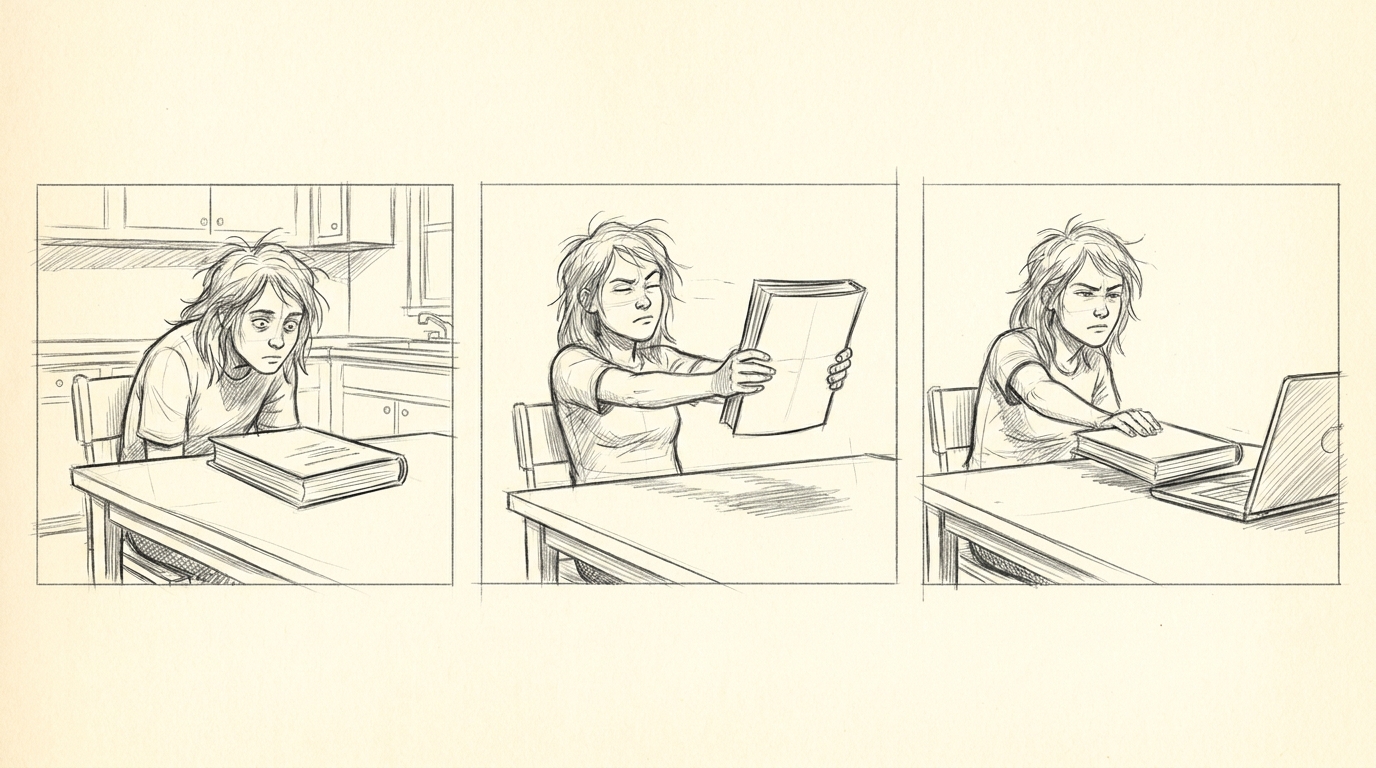
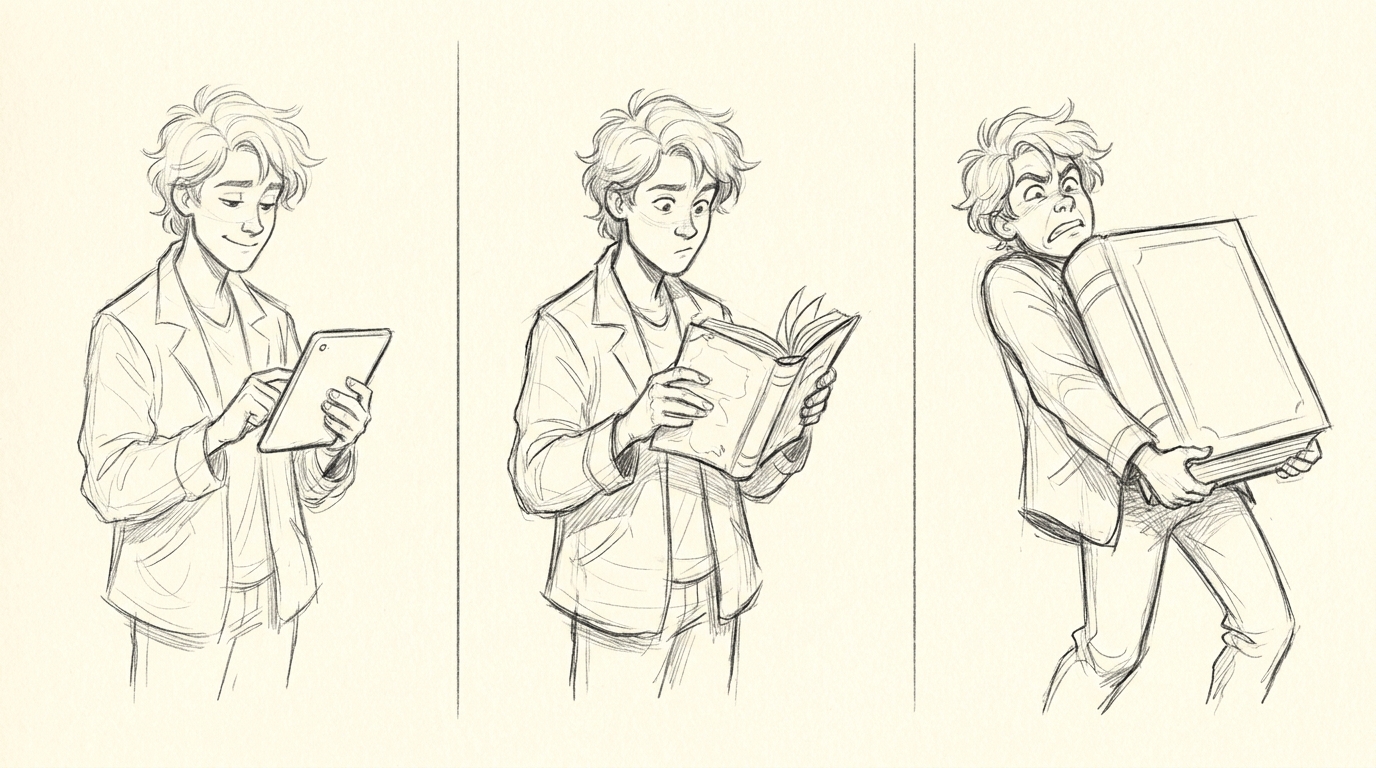
Every chapter opens with a three-panel board. Left to right, in time.
Chapter one
Nobody is coming
The decision, and why it is now a reasonable one.
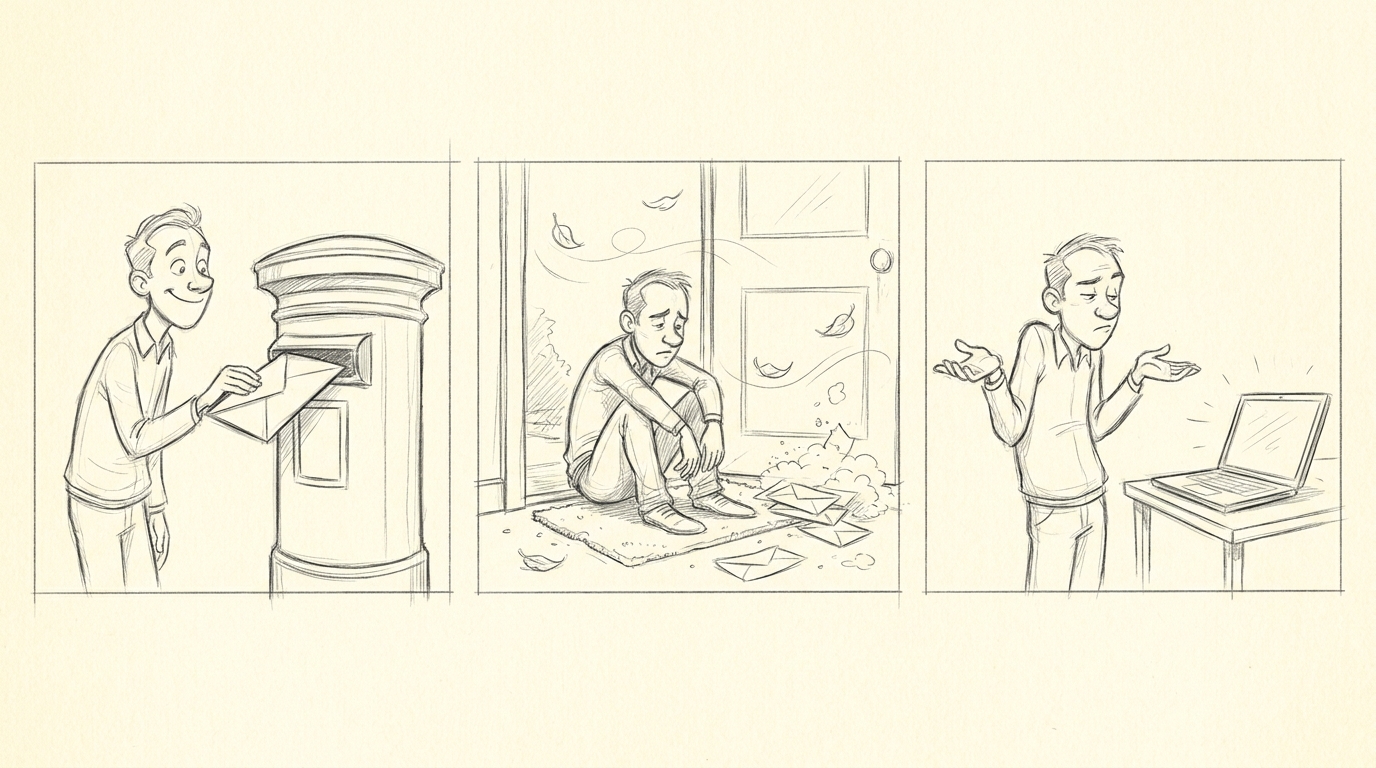
The old arrangement was that you wrote something, sent it to strangers, and waited. Most people waited a long time and then stopped writing. That arrangement produced a great deal of good literature and an enormous amount of silence.
What changed is not that publishing got easier. It is that the printing and distribution problem got solved by somebody else. Print-on-demand means no print run, no warehouse, no unsold boxes in your mother's garage. A book exists as a file until somebody orders it, at which point one copy is made.
What you are taking on
All of it. You are now the editor, the designer, the typesetter, the marketing department and the accounts department. Some of those jobs you will do badly, and the honest move is to know which and pay somebody for those specific ones — usually editing and the cover, in that order.
What you are not taking on
Risk, mostly. There is no print bill, no minimum order, no inventory. It is possible to publish a book for the cost of your own time and one proof copy, and the worst realistic outcome is that very few people read it — which is also the most likely outcome of the traditional route.
Not can I — you can, the machinery is free and takes an afternoon. The question is what is this book for. A book that exists to be sold, a book that exists to be given to fifty specific people, and a book that exists because you needed to finish it are three different projects with three different right answers about price, format and effort. Decide which before chapter eight, because the arithmetic only makes sense once you know.
Chapter two
What you are actually making
Ebook, paperback, hardcover — and why the answer is usually all three.
| Format | Good for | Watch out for |
|---|---|---|
| Kindle ebook | Reach, price flexibility, instant delivery, no printing cost at all | The delivery fee on the 70% tier — see below, it matters enormously for illustrated books |
| Paperback | The default physical object. People still want one they can give away. | Printing cost comes out of your royalty, and it scales with page count |
| Hardcover | Gift books, reference, anything that wants to look permanent | Much higher printing cost, and a narrower set of available trim sizes |
Publishing all three is usually right, because they are separate listings that share a manuscript and cost nothing to add. Different readers want different objects and there is no reason to choose on their behalf.
The 70% ebook royalty tier deducts a delivery fee based on file size — around $0.15 per megabyte in the US. A text novel at 2 MB pays about $0.30 a sale. An illustrated book at 15 MB pays over two dollars, which can drag an apparently generous 70% down toward the 35% you were trying to avoid.
The fix is not to abandon pictures. It is to compress them properly before uploading, and to check the sum for your actual file size rather than assuming the headline rate. For heavily illustrated work the print edition is often the better commercial object, and the ebook is the sample.
Chapter three
The tax interview
The screen where most people stop, and how not to.
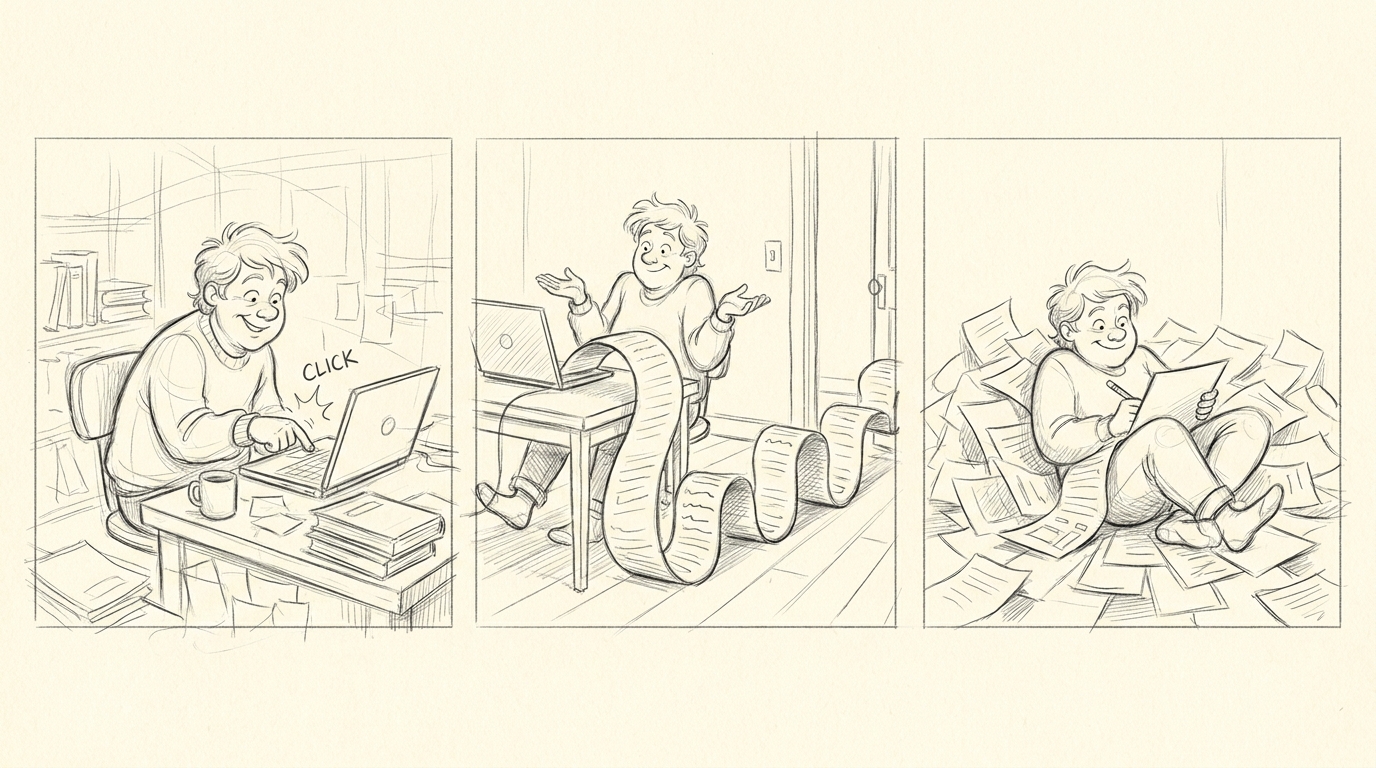
You will set up an account, upload nothing, and hit a wall made of American tax law. This is the single most common place people abandon the process, and it is entirely survivable.
Amazon is a US company paying you money, so it is obliged to establish what to withhold. If you are outside the United States and do nothing, the default withholding is punitive — historically 30% of your royalties, gone before you see them.
The interview is an online questionnaire, not a paper form. It is not long. Non-US individuals are generally completing the equivalent of a W-8BEN, and the operative question is whether your country has a tax treaty with the United States. Many do, including much of Europe, and where one applies the withholding on royalties drops substantially or to nothing.
What you need in front of you
- Your legal name and address as they appear on official documents.
- Your national tax identification number.
- Bank details for payment, in an account in your own name.
- Patience for approximately twenty minutes.
Rates, treaties and forms change, and they differ by country and by personal circumstance. This chapter describes the shape of the obstacle so you are not surprised by it. For what applies to you specifically, ask an accountant in your own country — it is one cheap conversation and it is the correct place to spend money.
One practical note that is not tax advice: complete this before you publish, not after. Royalties accrue from the moment a book sells, and a withholding rate set incorrectly at the start is tedious to unwind later.
Chapter four
The manuscript
Trim, margins, bleed, and the gutter nobody thinks about.
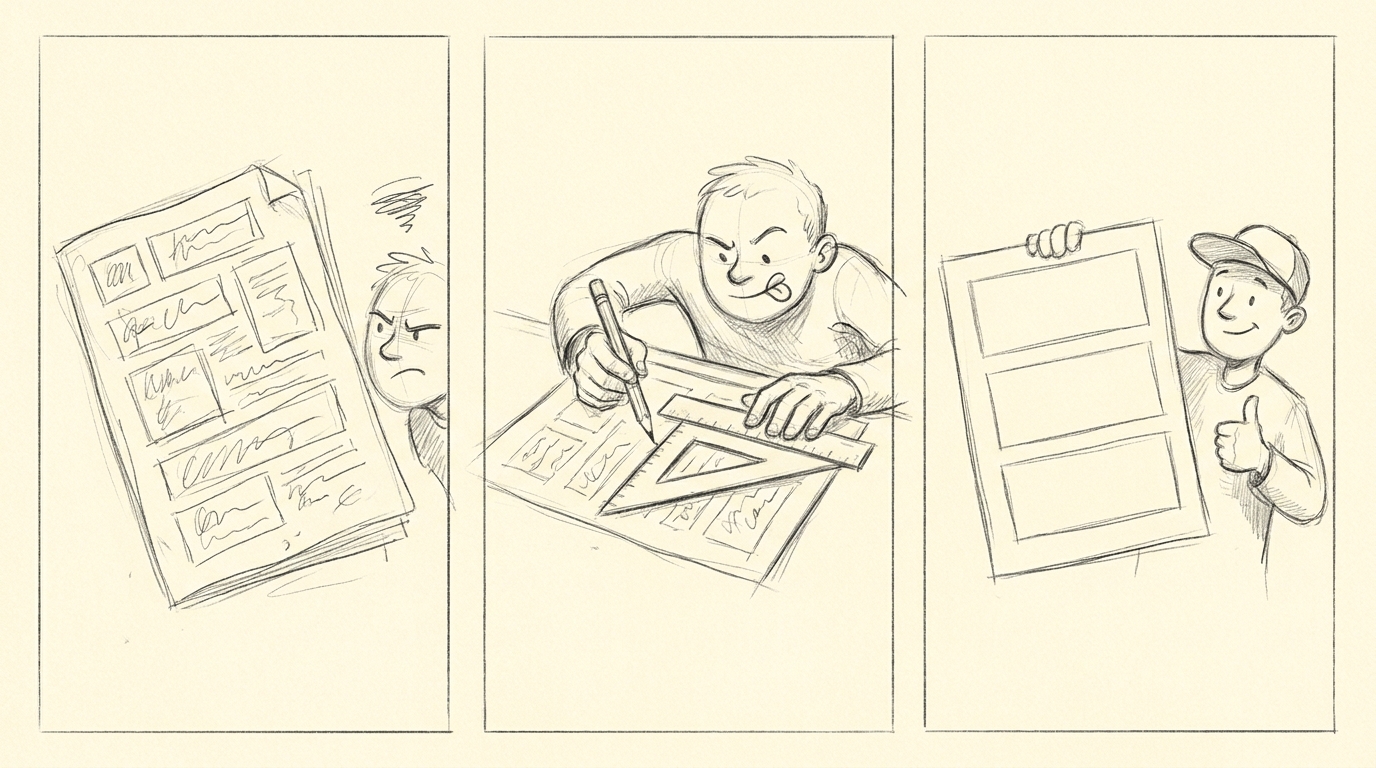
Trim size
The physical dimensions of the page. 6×9 inches is the workhorse for non-fiction and general trade books; 5×8 suits fiction and feels more novel-like in the hand; larger formats suit illustrated and technical work. Choose early, because it determines your page count, which determines your printing cost, which determines your minimum price.
One detail worth knowing: trim size affects printing cost through a regular versus large trim distinction that changes the per-page rate — on Amazon.com, black ink runs from roughly $0.012 to $0.017 per page depending on which side of that line you sit. Crossing it on a long book is not trivial.
The gutter
The inside margin, next to the spine, and the thing beginners forget. A printed book does not open flat, so text set with equal margins all round disappears into the fold. The inside margin must be wider than the outside, and it must get wider as the book gets thicker, because a 400-page book curves more than a 120-page one.
Bleed
If any image is meant to run off the edge of the page, it must be drawn past the edge and the file set up with bleed, because printing and trimming have tolerances. If nothing runs to the edge, you do not need it. Cover finish and bleed settings do not change your printing cost, so this is a purely visual decision.
The rest of the object
A book is not only chapters. Half-title, title page, copyright page, contents, and at the back an about-the-author and anything else you want. These are cheap to do, they cost a handful of pages, and their absence is the clearest signal that a book was made in a hurry.
Export to PDF and look at every page. Not skim — look. Widows, orphans, chapters starting on the wrong side, a stray blank page, a running header still saying "Chapter One" on page 200.
Chapter five
The cover
The only part of your book most people will ever see.
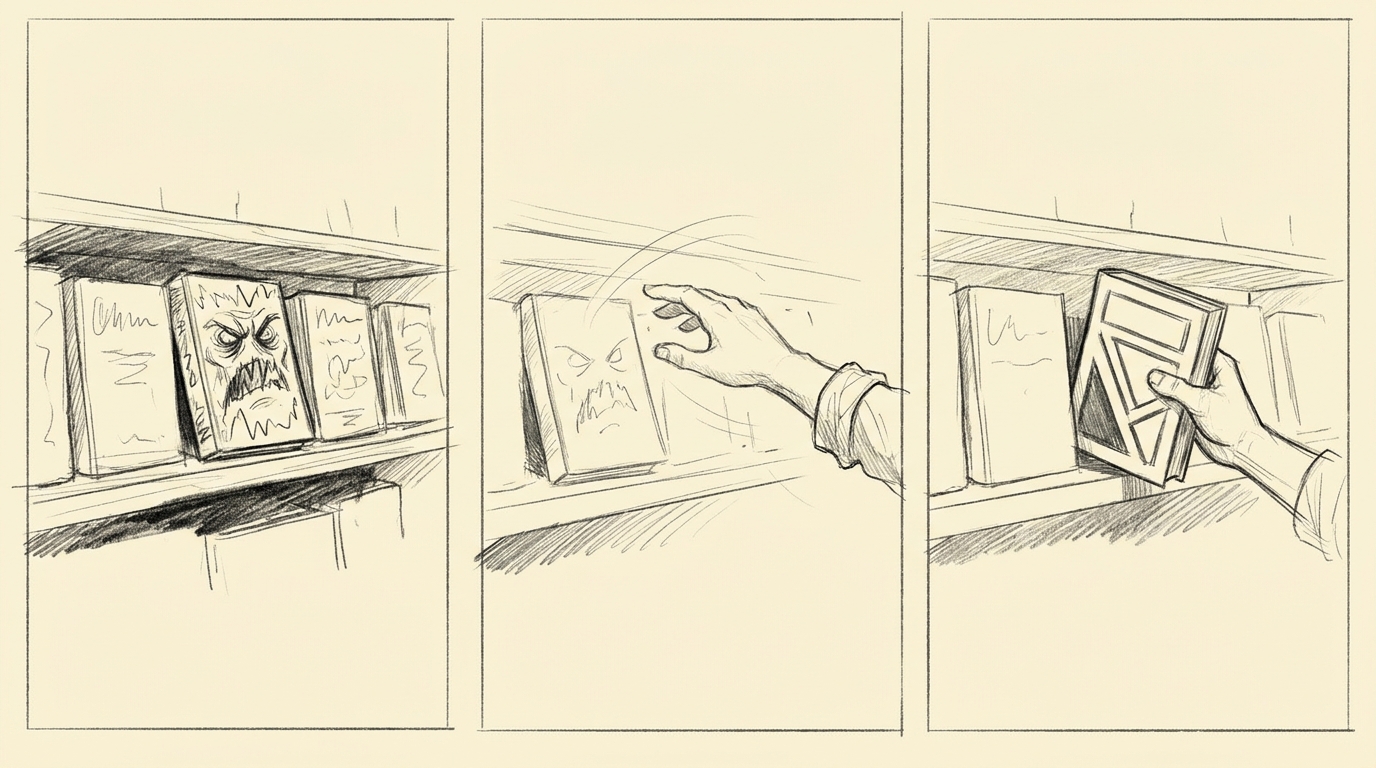
This is where to spend money if you spend money anywhere. Not because design is sacred, but because the cover is doing a specific measurable job under specific brutal conditions.
The conditions
Your cover will first be seen at roughly the size of a postage stamp, in a grid of forty others, by somebody scrolling. It will not be seen at full size until after the decision has been made. Design accordingly, and test by shrinking your cover to thumbnail and looking at it beside real competitors in your category.
What survives that test
- A title that is legible at thumbnail size. Big, high contrast, few words. Elegant thin type disappears.
- One idea. A cover that contains three concepts reads as none.
- Genre signals. Covers in a category look alike because readers use the resemblance to navigate. Being distinctive within the convention works; ignoring the convention reads as "not for me".
- Your name small, unless people already know it.
The print cover is a different object
An ebook cover is a rectangle. A print cover is a single flat sheet comprising back, spine and front, sized to your exact page count — because spine width depends on how many pages the book has, and the page count is not final until the interior is. KDP generates a template for your specific book; use it rather than guessing.
The back cover carries the description, and it is worth as much attention as the front. Somebody who turns the book over is already interested and can still be lost.
Chapter six
The ISBN question
The free one, and what it quietly costs you.
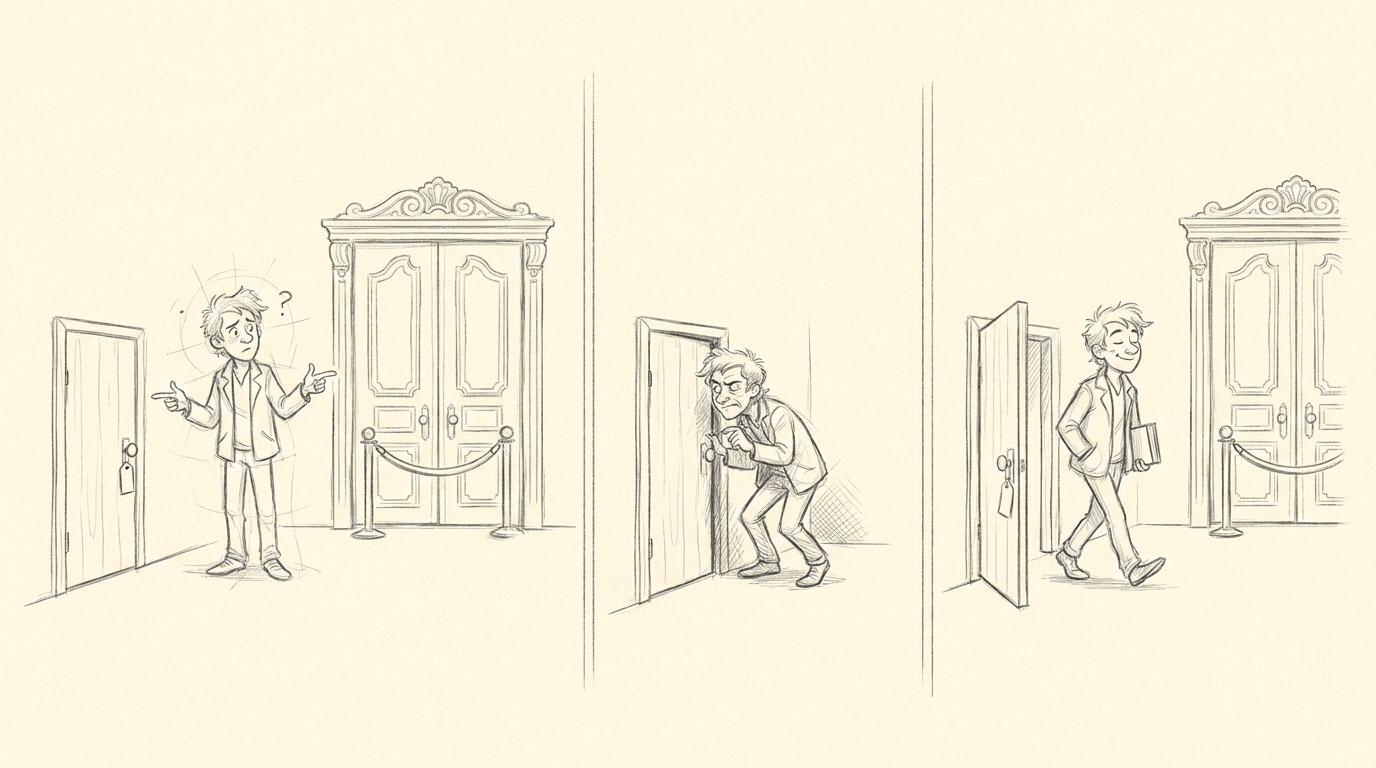
An ISBN is the identifier that lets a book be ordered by a shop that does not know you. Each format needs its own — paperback and hardcover are separate books to the system. Kindle ebooks do not need one at all.
The two options
Take Amazon's free ISBN. Costs nothing, takes one click, and works. The catch: it is registered with Amazon as the publisher of record, and it is tied to their platform — you cannot take that number elsewhere.
Buy your own. Bought from the ISBN agency for your country, and prices vary enormously by country: some sell singly and expensively, some in blocks, and some issue them free. You appear as the publisher, and the number travels with the book anywhere.
Which to choose
If the book is going on Amazon and you are not building an imprint, take the free one and stop thinking about it. If you intend to publish several books, want your own imprint name on the copyright page, or plan to distribute through other channels as well, buy your own from the start — retrofitting means a new edition, a new listing, and losing any reviews attached to the old one.
For Mantra Productions the answer was to own the numbers, because there was always going to be more than one book. That is a decision about intent rather than about economics.
Chapter seven
Metadata is the shelf
Title, subtitle, categories, keywords — where your book actually lives.
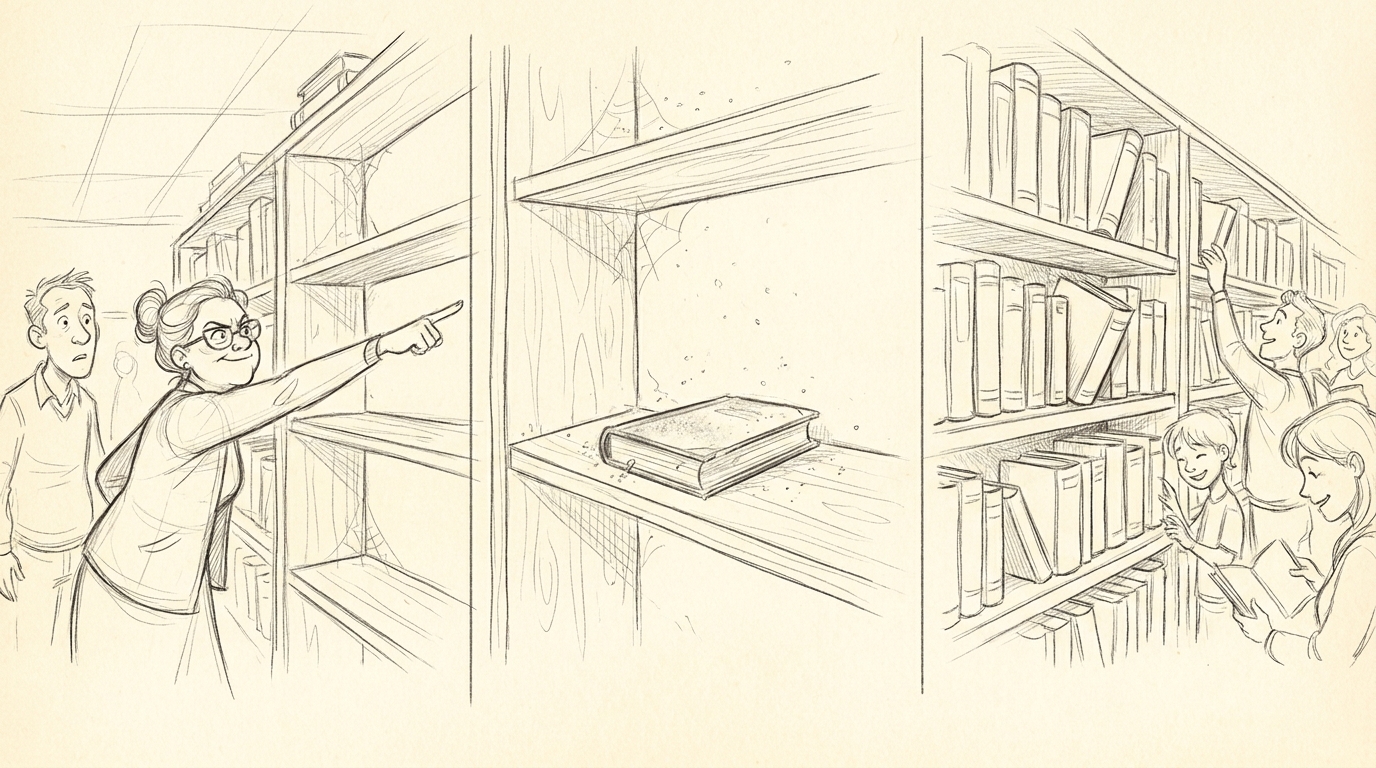
There is no shop. There is a search box and a set of category listings, and your metadata is the entirety of how anybody who is not your friend will ever find you.
Title and subtitle
The title can be evocative. The subtitle is where the searchable, concrete description goes, and non-fiction lives or dies by it. The Patient Ground tells a search engine nothing; The Patient Ground: a field book on permaculture, the evidence, and Mediterranean design tells it everything.
Categories
You choose where the book is filed. The instinct is to pick the biggest category available, and it is wrong: in a huge category you are invisible at rank four thousand. In a precise, smaller one you can be visible, and visibility compounds because rank drives placement. Pick the category that accurately describes the book and is as specific as honesty allows.
Keywords
A small number of slots, and the common mistake is stuffing them with single words. Use them for phrases somebody would actually type — the way a real person describes a problem, not the way a marketer describes a product. Do not repeat words already in your title; they are indexed anyway, and the slot is wasted.
The description
The block of text on the product page, and it is sales copy rather than a synopsis. First line does the work — it is what shows before "read more" is clicked. Do not summarise the plot. Say what the reader gets and who it is for.
Find five books that are genuinely like yours and already selling. Read their subtitles, note their categories, read their descriptions, and look at their covers at thumbnail size. You are not copying — you are learning the conventions of the shelf you want to be on. Every one of those decisions was made by somebody who tested it.
Chapter eight
The arithmetic
Royalties, printing costs and price bands, with the sums shown.
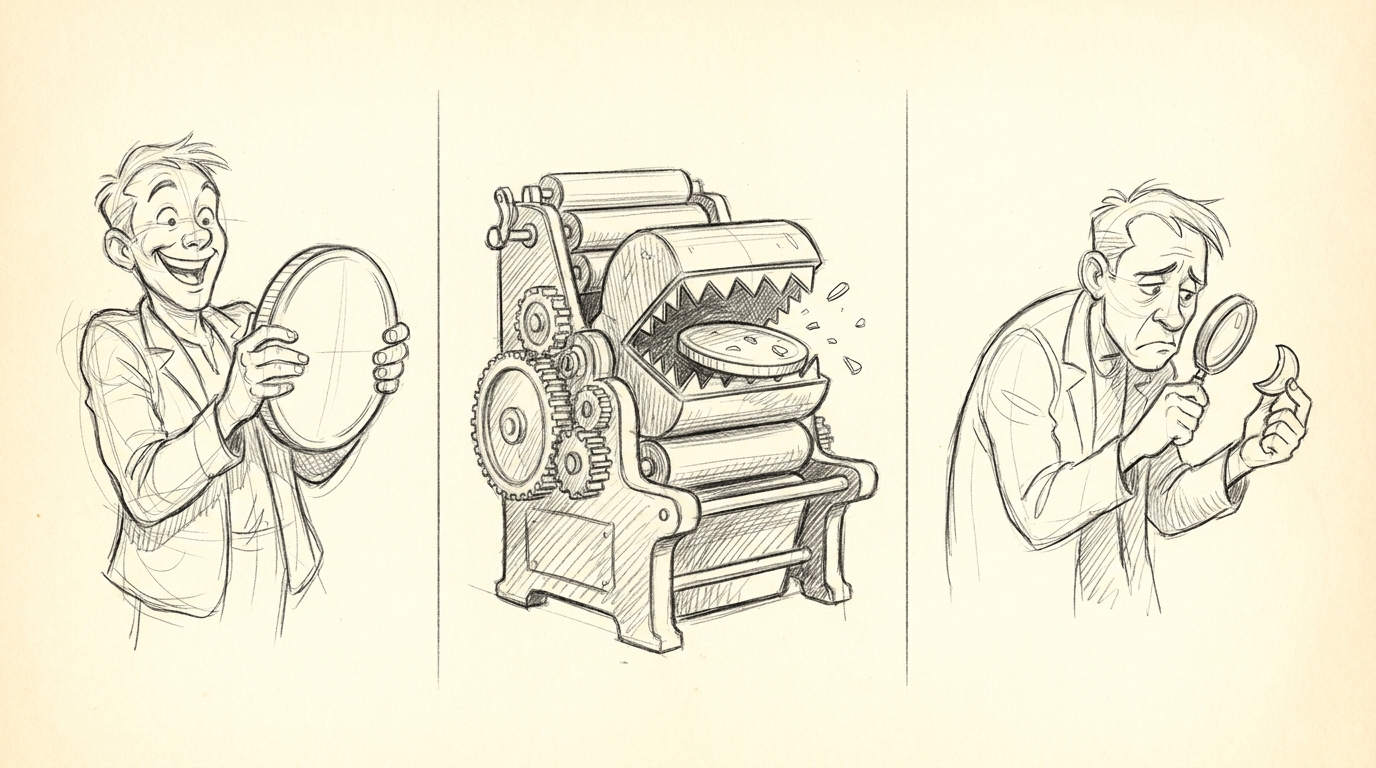
Every royalty, in every format, comes from one equation:
(royalty rate × list price) − costs = what you get
All the complexity is in which rate applies and what counts as costs. Figures below are for Amazon.com in US dollars, as published in 2026, and are the reason this chapter has a date on it.
Kindle ebooks
- 70% if you price between $2.99 and $9.99, minus a delivery fee of about $0.15 per megabyte. Territory restrictions apply.
- 35% at any price, no delivery fee, available globally.
Worked: a $9.99 ebook at 2 MB earns roughly $9.99 × 0.70 = $6.99, minus $0.30 delivery, so about $6.69. The same book at 15 MB pays about $2.25 in delivery and lands nearer $4.75 — still better than 35%, but not the number on the tin.
Print books
Since a change in June 2025, the print rate is tiered by price on Amazon stores:
- 60% of list price minus printing cost, at $9.99 and above.
- 50% minus printing cost, at $9.98 and below.
- 40% minus printing cost through Expanded Distribution — bookshops and libraries.
Printing cost is a fixed amount plus a per-page charge, driven by page count and ink type. Cover finish and bleed do not affect it.
| Book | Approx. printing cost |
|---|---|
| 200-page black-and-white paperback | ~$3.40 |
| 300-page black-and-white paperback | ~$4.60 |
| 300-page black-and-white hardcover | ~$9.25 |
| 200-page premium colour paperback | ~$14.00 |
Worked: a 300-page black-and-white paperback at $14.99 → $14.99 × 0.60 = $8.99, minus $4.60 printing = about $4.39 a copy.
- The $9.99 cliff. Pricing a print book at $9.98 drops you from 60% to 50% and you still pay the full printing cost. A book priced just under a round number can earn dramatically less than the same book a penny above it. Check both.
- Colour. Look again at that table. A 200-page colour paperback costs around $14 to print, which means it cannot be sold at $14.99 at all — the royalty would be negative and KDP will not permit it. Illustrated books in colour are a genuinely different business, and the usual answers are a much higher price, black-and-white interiors, or making the illustrated edition digital.
- The minimum price is not your choice. Your floor is roughly printing cost ÷ 0.60, because the royalty cannot go below zero. Long books have high floors, and readers do not adjust their expectations to your page count.
Payment arrives monthly, roughly 60 days after the end of the month in which the sales happened — about 30 days for Expanded Distribution. Budget accordingly; the first money is further away than people expect.
Chapter nine
The ninety-day handcuff
KDP Select, exclusivity, and when it is worth it.
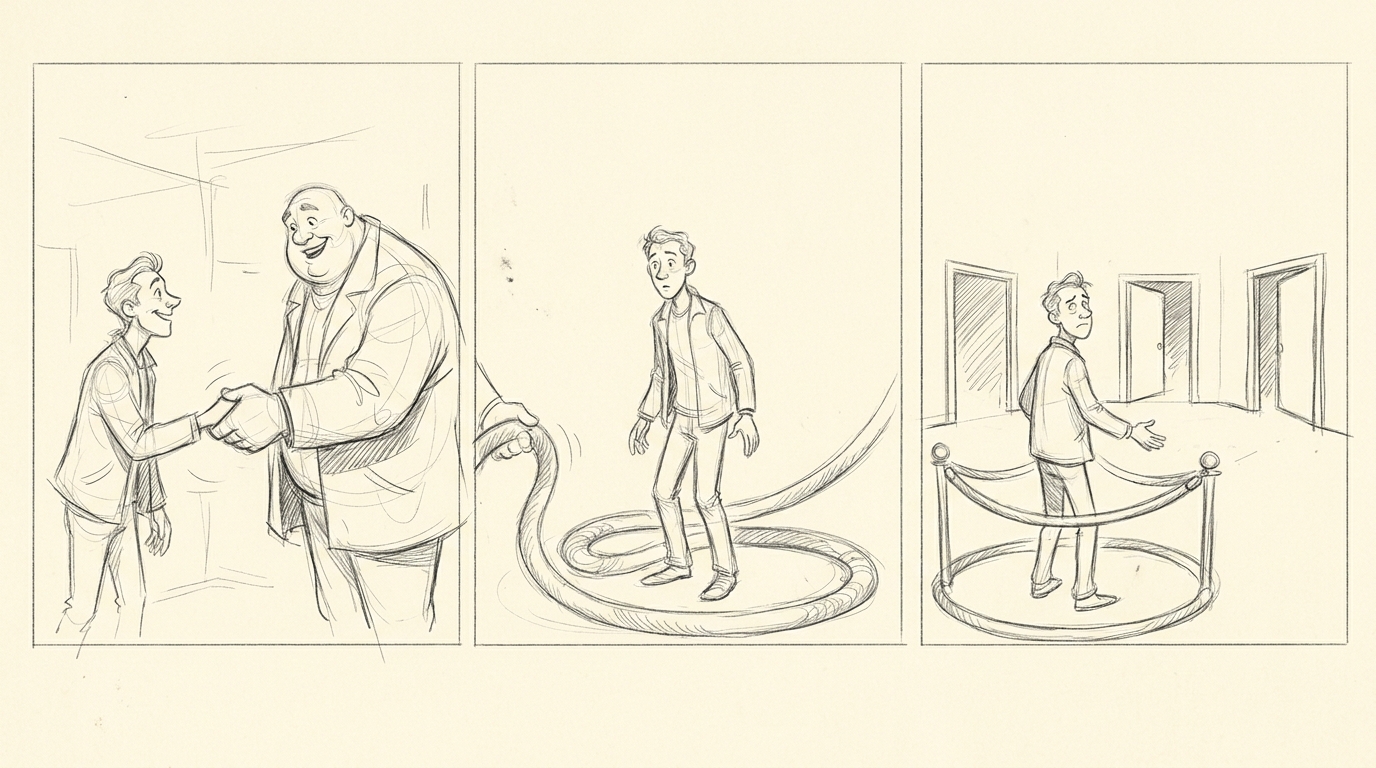
KDP Select is a bargain: enrol your ebook exclusively with Amazon for 90 days, and in exchange it enters Kindle Unlimited — where subscribers read it free and you are paid per page actually read — plus you get promotional tools.
Exclusivity applies to the ebook only. Your paperback and hardcover can be sold anywhere.
When it is a good deal
Genre fiction, mostly. Romance, thriller, science fiction, fantasy — categories where Kindle Unlimited readership is enormous and readers consume voraciously. For a novelist in those categories the per-page earnings plus the promotional access usually beat what the other retailers would have paid.
When it is not
Non-fiction, reference, and anybody with an existing audience elsewhere. If people already find you outside Amazon, locking the ebook away from Kobo, Apple Books and everywhere else costs you real sales for a Kindle Unlimited readership that is smaller in your category anyway.
It renews automatically unless you turn it off, which is worth a calendar reminder on day 80. And a book that has been in Kindle Unlimited can leave — this is a 90-day decision, not a permanent one, which makes it a reasonable thing to try once and measure.
Chapter ten
Order the proof
Do not skip this. Everybody skips this.
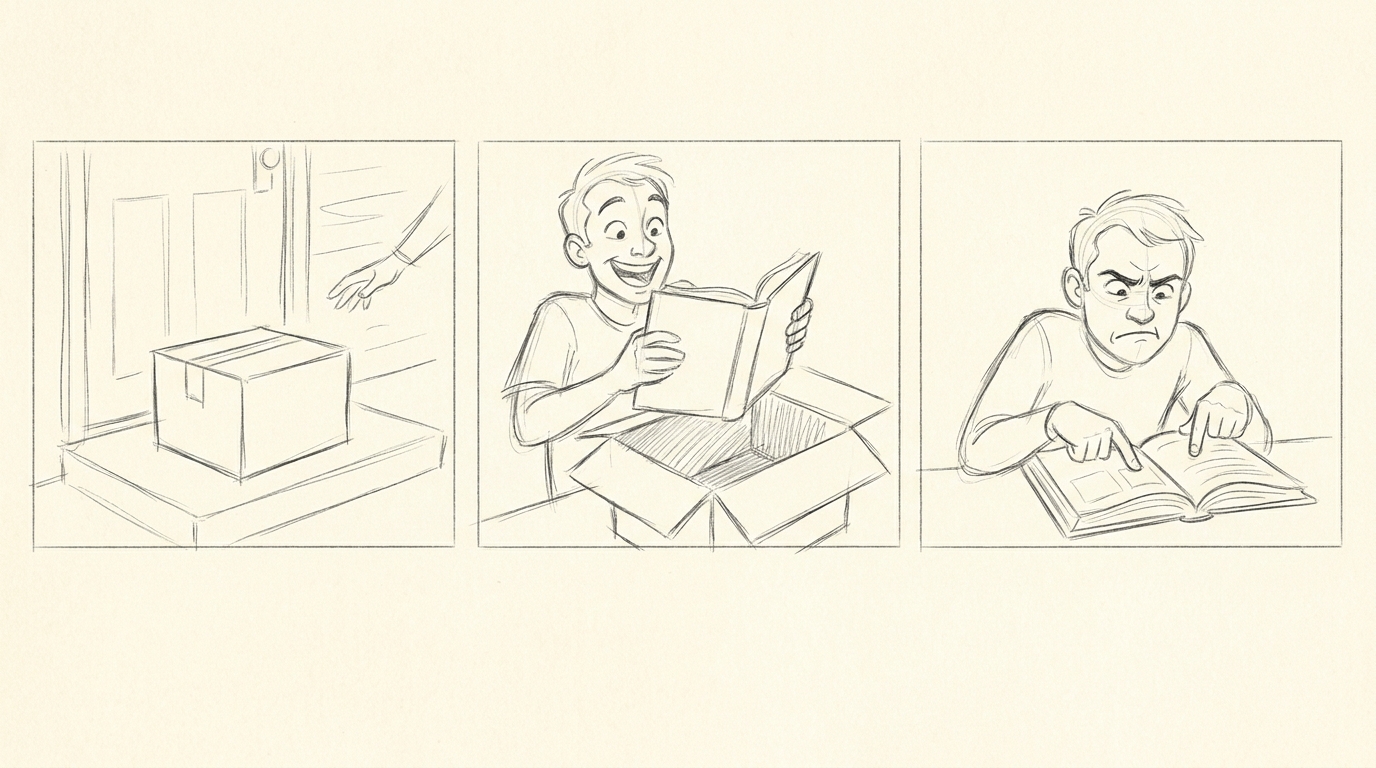
You will have looked at the PDF forty times. Order the physical copy anyway, wait the week, and read it on paper before you press publish.
What only appears in your hands
- The gutter. Chapter four. On screen the inside margin looked generous. In a bound book it may not be.
- Ink weight. Type that looked elegant on a backlit screen can print grey and thin, and images that looked rich can print muddy. Print is darker and lower contrast than you expect.
- Spine alignment. Print-on-demand has tolerances. Text too close to the spine edge on the cover will look wrong on some copies.
- The object. Whether it feels like a book or like a bound document. This is not vanity — it is the difference between something a reader keeps and something they do not.
- Your own errors. Reading on paper uses different attention. You will find typos you have read past a dozen times on screen, and this is reliable enough to be a technique rather than a superstition.
A proof costs the printing cost plus shipping — for most books, less than a restaurant meal. It is the cheapest insurance in the entire process and the most commonly skipped step, because by that point you badly want to be finished.
Not at your desk. The room where you wrote it is contaminated with your intentions — you will read what you meant instead of what is there. Take it somewhere else, and take a pencil.
Chapter eleven
Launch week
The party popper in the empty room, and the reviews problem.
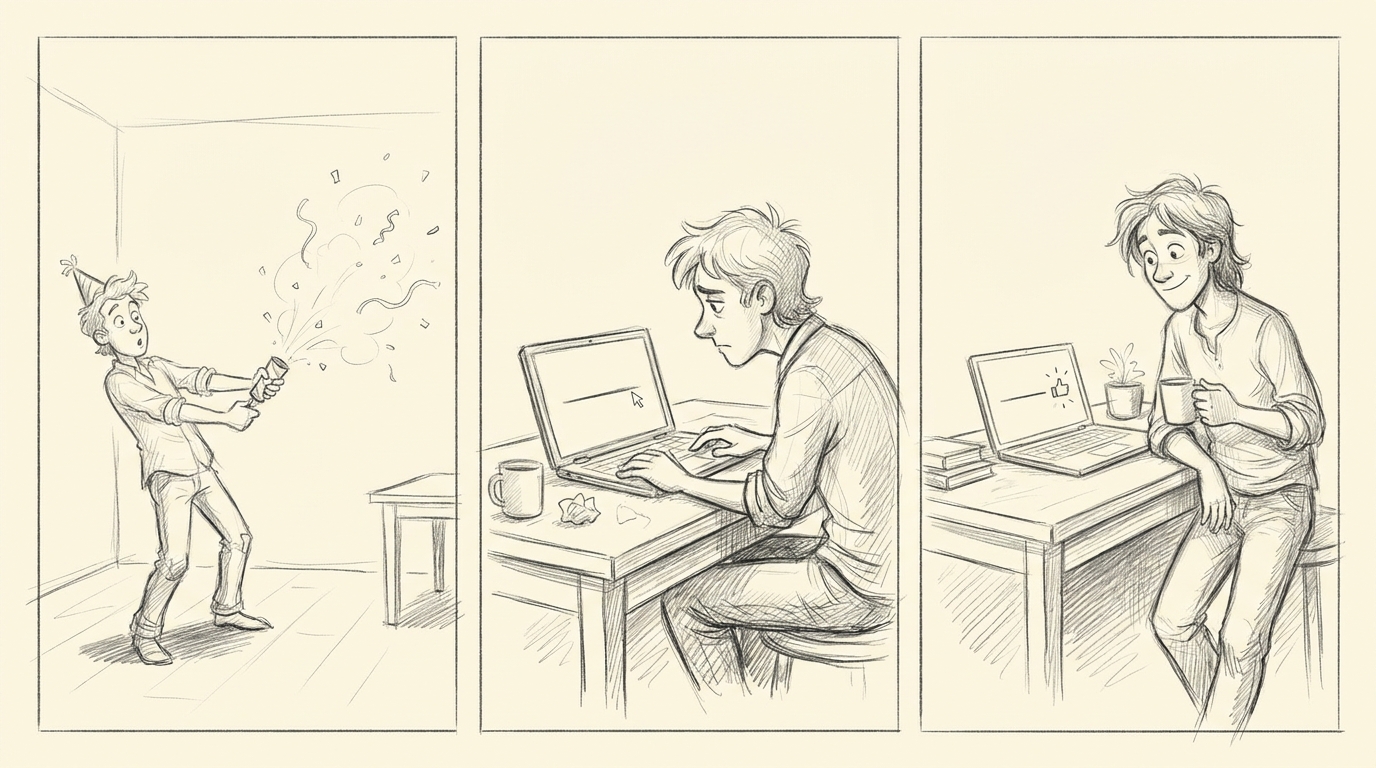
The book goes live. Nothing happens. This is normal, universal, and worth being warned about, because the gap between pressing publish and anything occurring is where most first-time publishers conclude they have failed.
The reviews problem
Reviews drive visibility, visibility drives sales, sales drive reviews. Getting the first few is genuinely hard, and it is the one place where people reliably do something stupid.
Do not buy reviews. Do not swap reviews in a group. Do not have your family post them from accounts that share your surname and address. Amazon detects this competently, and the penalty ranges from silently deleted reviews to a closed account with royalties withheld. The upside is small and the downside is your whole publishing operation.
What is legitimate: telling people the book exists. Asking readers who liked it to say so. Sending advance copies to people with a genuine interest. A polite line at the back of the book noting that reviews help. That is slow and it is the only durable route.
What actually helps in the first month
- Your own audience first, whatever it is — an email list, a workplace, a community, forty people who know you write.
- The metadata, revisited. Chapter seven. If nothing is happening, the shelf is more often wrong than the book.
- A period at a low price to gather early readers, if it suits the book.
- Patience with advertising. Amazon's ad platform works, and it will also take your money cheerfully while you learn. If you try it, start small, and treat the first month's spend as tuition.
Chapter twelve
The long tail, honestly
What actually happens, and what makes it worth doing anyway.
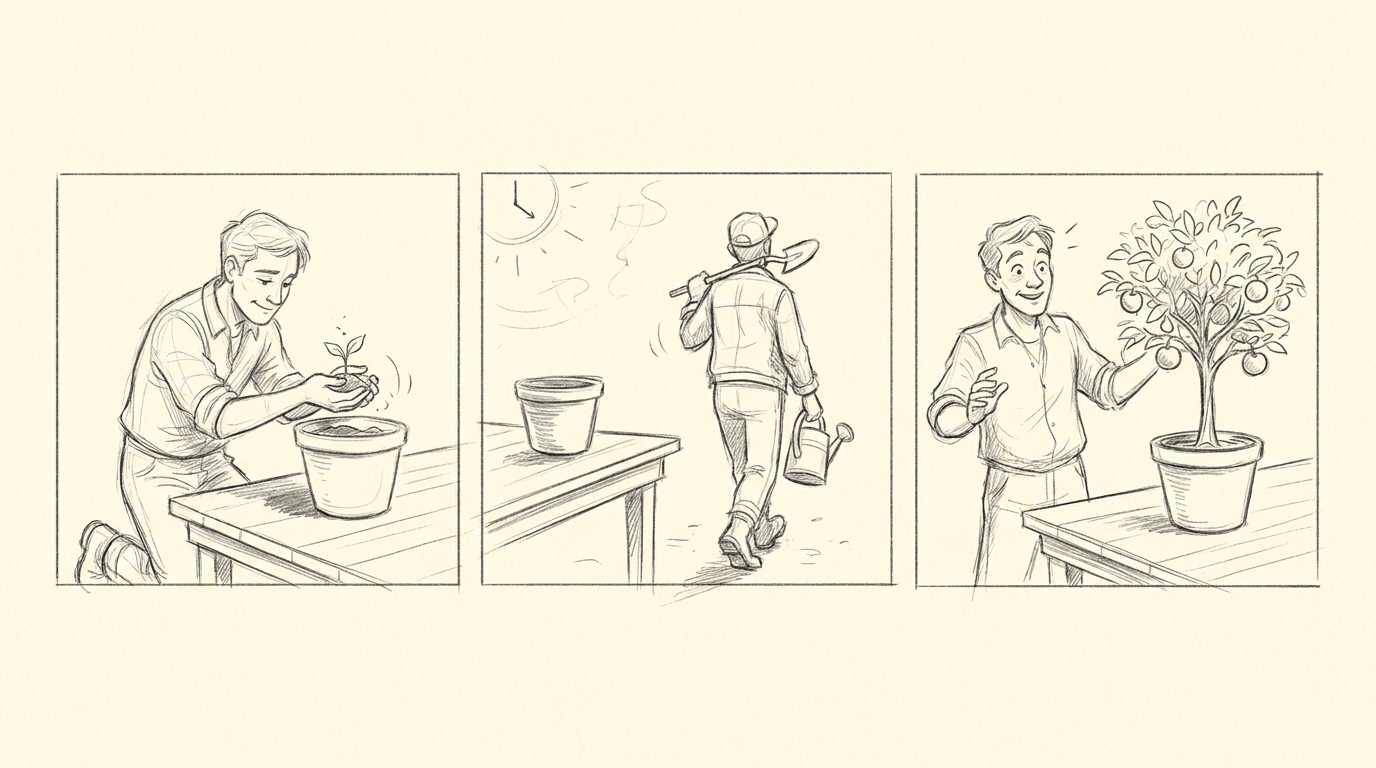
Here is the part the courses leave out.
Most self-published books sell very few copies. Not because they are bad — many are fine — but because discovery is the hard problem and always was, and removing the printing obstacle did nothing about it. The people making a living at this overwhelmingly have many books, in a genre with hungry readers, published steadily over years.
One book, published once, will most likely sell to the people who already know you, and then a thin trickle. That is the realistic case and it is worth knowing in advance, because the disappointment usually comes from an expectation nobody stated out loud.
What makes it worth doing anyway
- It exists. Permanently, orderable by anybody, findable by somebody who needs exactly it. That was not available to a private person twenty years ago at any price.
- It compounds. The second book is much easier than the first, because you already know all eleven tedious places. The tenth is easier still, and back-catalogue is how this actually works.
- It is a real object to give someone. Never underestimate this. A printed book handed to a person is a different act from a link.
- It finishes the work. A manuscript in a folder is not done. Publishing forces the last ten percent that most writing never gets, and that alone changes the writing.
Publish, then write the next one. Do not spend six months marketing a single title — the marginal hour is nearly always better spent on the next book, because a catalogue markets itself in a way a single book cannot. Everything in this field book is machinery for getting one thing out of the door so you can start the following one.
Apparatus
Sources
Where the numbers came from, with dates.
The figures in chapters two, four and eight were gathered on 20 August 2026 and refer to Amazon.com in US dollars. They will go stale, which is why this section exists.
- KDP royalty and pricing guides published and revised through 2026, including the June 2025 change that introduced the tiered 50% / 60% print royalty at the $9.99 threshold, and the 40% Expanded Distribution rate.
- Kindle royalty structure: 70% between $2.99 and $9.99 with a delivery fee of approximately $0.15 per megabyte, or 35% at any price with no delivery fee and no territory restriction.
- Printing-cost estimates: 200-page black-and-white paperback ~$3.40; 300-page ~$4.60; 300-page hardcover ~$9.25; 200-page premium colour ~$14.00. Per-page black ink from roughly $0.012 to $0.017 depending on regular versus large trim.
- The minimum-list-price rule — printing cost ÷ 0.60 — and the fact that KDP will not permit a price producing a negative royalty.
- Payment timing: monthly, approximately 60 days after the end of the sales month; approximately 30 days for Expanded Distribution.
- KDP Select: 90-day ebook exclusivity, Kindle Unlimited participation, automatic renewal.
Check everything against KDP's own pricing tool before you publish. It shows your exact printing cost and royalty for your actual page count and trim, and it is authoritative in a way that any book, including this one, is not.
Related
- The Chat That Forgets — how the Mantra books are built and published on the web rather than through a shop.
- The Mantra Manifest — the working principles this series is built to.
House rule
What I could not verify
Stated as plainly as what I could.
- I have not published a book through KDP. The Mantra field books are published on the web, free, and this guide is assembled from KDP's published rules and from current secondary sources rather than from my own account dashboard. That is a real limitation and you should weigh it.
- The figures are US-dollar, Amazon.com, August 2026. Other marketplaces have different printing costs and different price thresholds, and books sold on Amazon.co.uk or in the EU are printed and billed locally at rates that are not simply the dollar figures converted.
- The printing costs are approximate and taken from published calculators and guides rather than from KDP's own tool run against a real manuscript. Treat them as the right order of magnitude, not as quotations.
- The royalty rules changed in June 2025 and could change again without notice. Every number in chapter eight has a shelf life.
- Chapter three is not tax advice and says so in the chapter. Treaty rates, forms and thresholds vary by country and by circumstance, and I am not qualified to advise on any of them.
- ISBN costs and availability vary enormously by country — free in some, expensive in others — and I have not surveyed them. Check your own national agency.
- The claim that most self-published books sell very few copies is well attested in industry discussion but I have not cited a specific dataset for it, and reliable figures are genuinely hard to obtain because the platforms do not publish them.
- Advertising is mentioned and not taught. One paragraph is not a guide to Amazon Ads, and I have deliberately not pretended otherwise.